Economics Explained: The Hidden Forces That Run Our World: You are human. You need food, you need a home, you need a good life and if your neighbor bought a Fortuner, you want a big car like that too. But here’s the problem. In this world, not everything is available for everyone. Not everyone can get a big house. Not everyone can get a crores-worth salary. Not everyone can get a big bungalow by the sea. And this is where economics begins.
What is Economics Really About?
Economics doesn’t start with the stock market. Economics doesn’t start with billionaires. Economics starts with a small problem called scarcity running short, limited resources. Things in this world are limited.
Think about it if petrol was unlimited, gold was unlimited, vegetables was unlimited, everything in this world was unlimited, or even your time and energy was unlimited, would there even be a thing called economics? Would we need to invent something called money?
Money is a story that humans created for themselves, and everyone agreed to believe it. Because in reality, a ₹500 note is just a story. It costs ₹50 to make that note, but we all agreed it’s worth ₹500. We believed a story because economics is born only when resources are limited.
Things we have are limited, but desires are unlimited. Pay attention human wants, what people need, are infinite. But resources are limited. This is where all of economics is born.
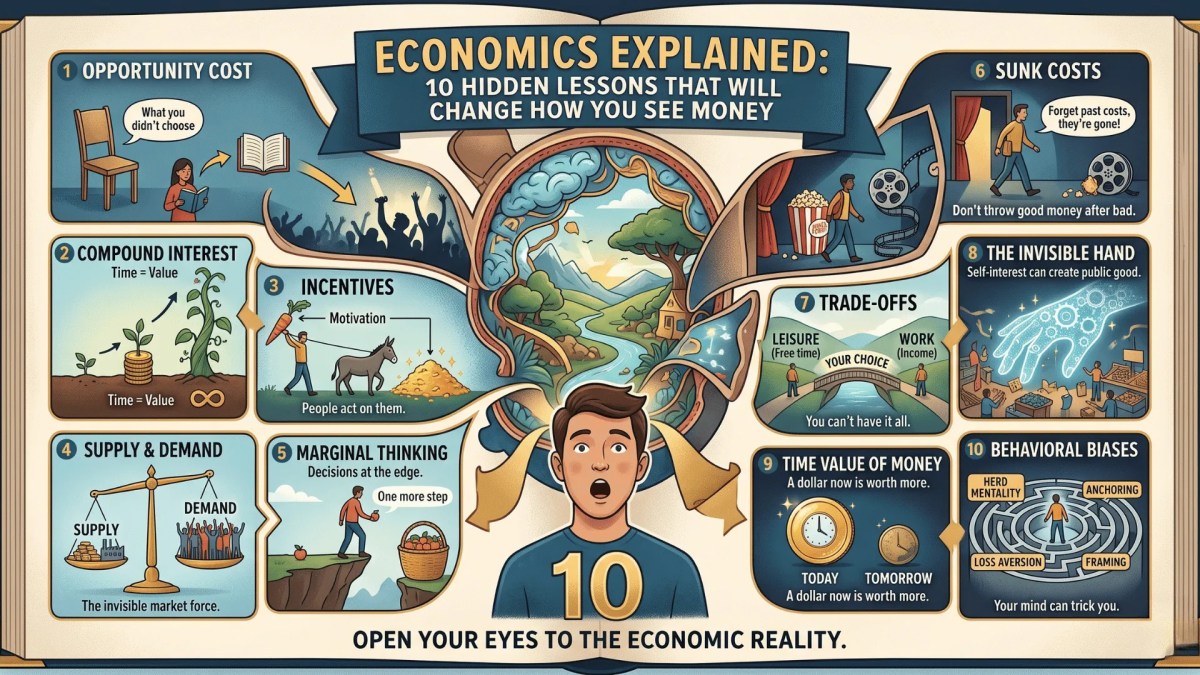
Lesson 1: Scarcity and Choice
When you can’t have everything, what do you have to do? You have to make choices. You have to make decisions. Right now, you cannot do 100 things. When you do one thing, you leave something behind.
You’re watching this video right now. What does that mean? It means there’s something else you’re NOT doing. Maybe you’re not scrolling Instagram. Maybe you’re not watching Netflix. Maybe you’re not talking to friends. Every choice has a hidden cost. Economics calls this opportunity cost.
Listen carefully to this opportunity cost concept. It’s not the price of what you got. It’s the price of what you left behind. Understand?
- If you chose IAS preparation, you probably left behind a 4-year job
- If someone chose business, they left behind a fixed salary
- If someone chose comfort, they probably left behind success
Every decision has a hidden price behind it. And this is the first lesson of economics.
Lesson 2: Trade The Win-Win Principle
When resources are limited, what will people do? They will trade, exchange, do transactions. Suppose a farmer in Rajasthan can only grow wheat. Someone in Kerala can only grow spices. Neither has everything. So what will they do? They’ll exchange. This is called trade.
And pay attention trade doesn’t happen because people are good. Trade doesn’t happen because they’re helping each other. Trade happens because both sides benefit. This is one of the most beautiful principles of economics. Win-win. Both benefit, and trade happens. This is how economics works.
Lesson 3: Comparative Advantage
Now here’s another interesting concept comparative advantage. The name sounds dangerous but the concept is very simple.
Suppose there are two people. One person is good at coding but does designing just okay. The other person is excellent at designing but can barely manage coding. If both try to do everything themselves, their own work plus the other’s work growth will be a bit slow. If both collaborate, specialize, they can move forward much faster.
A YouTuber starts a channel, does editing himself, does research himself. But when he does this, he can only upload one video per week. But there’s a guy who only knows editing but can’t record, can’t write. This is where economics enters. A cycle begins where that YouTuber saves his time by hiring an editor, and the editor gets hired.
When a YouTuber teams up with an editor and starts creating something in the market after any discovery in this world, to produce more of it, what does a company do? It brings many people together, makes a batch, creates a group by getting work done from all of them, builds management for all of them, and sells its products in the market. This is what we call economics.
The connection of economics is this if everything is limited, your time is also limited. Your energy is also limited. That’s why we all create things through collaboration. You don’t need to be best at everything. You just need to be relatively better at one thing. And this is why the world runs.
This is why someone becomes a doctor, someone becomes an engineer, someone becomes a teacher, someone becomes a businessman and all of them together create win-win situations. In very simple words, everyone has their shop, and everyone earns so that everyone can buy each other’s things. Everyone focuses on their own strength, and this is trade. This is the foundation of civilization. This is why humans have progressed so much.

What Have We Learned So Far?
Scarcity things are limited.
Choice whatever you choose, there’s a hidden cost behind it. Opportunity cost. There’s a cost of not doing, of losing something.
Trade we collaborate with each other.
Comparative Advantage many people come together to fulfill each other’s needs.
Put these five things in a box and shake it. What happens? Suddenly, a market is born.
Lesson 4: Markets and Incentives
Market is not a place. Market is a system. Where buyers and sellers meet. In old times, the village mandi was the market. Today, Amazon is a market. Flipkart, Swiggy, Zomato, stocks. In the coming times, AI marketplaces will also be markets.
But the question is how does a market run? What’s its engine? What’s the fuel? What’s its battery? What’s the energy source behind it? The answer is incentives.
What is an incentive? Motivation. What’s the greed behind your doing something? What’s the math? What’s the need? What’s the want? Humans run on incentives. If I tell someone you’ll get ₹50 for this work, and another person tells them the same work in the same time will get ₹500 where will they go? Toward ₹500. Why? Incentives.
Thomas Sowell’s Wisdom
Thomas Sowell explained one thing again and again in his 700-page book “Basic Economics”: “People respond to incentives, not intentions.”
Humans don’t run on desires. They run on rewards.
The Maryland Millionaire Tax Example (2008)
In 2008, the Maryland state government needed money. So they thought let’s tax rich people. They had 8,000 millionaires at that time. Calculation showed the government would get extra crores in taxes every year. Let’s do it.
First year, the government felt good. Other people also felt good rich people are being taxed. Fair enough. But when the count happened the second year, it turned out 2,000 millionaires had disappeared. They ran away. Why?
Because rich people aren’t emotional. They’re economic. The government thought they would collect more money. But what did economics say? What happened in economics was that you were giving people incentives to leave the state. You were encouraging them. What should we have learned?
Humans do what they get encouragement for. What feels convenient, comfortable, or more, better. And that’s exactly what happened millionaires left, crorepatis left, businesses left, jobs left, tax revenue fell.
India’s License Raj vs. 1991 Economic Reforms
Before 1991, India had the License Raj. Want to open a new business? Import something from outside? Expand your business? You needed government permission for everything. There, people had only one incentive keep the government happy. Whether business grows or not.
The result? For almost 44 years, the country had almost zero growth. But as soon as the economy opened in 1991, the incentive changed compete, innovate, grow, earn money. In simple words, the reward for doing business increased a bit. A huge heavy tax was also removed. And the result of this changed incentive was that our economy, which was at $270 billion, has now reached $3.7 trillion. Meaning in 33 years, this country has moved forward 13 times.
Lesson 5: Incentives Rule Your Life Too
Pay attention this isn’t just the government’s story. Your entire life also runs on this rule.
- If you reward distraction, encourage it, discipline will die
- If society rewards show-off, people will buy luxury on EMI
- If schools only reward marks, children won’t learn, they’ll memorize
- If a teacher says marks are important, what’s the incentive for children? Marks. So creative children will look average, and average memorizers will become toppers
The teacher’s intention was good children should progress. But why did the outcome turn bad? Because the world runs on incentives, not intentions. The intention was that children should study. But what was the incentive? Marks. The incentive should be that if you do creative work, you’ll be rewarded.
If social media platforms’ algorithms reward fake life, people will create fake life and they are. If Indian audiences reward cricketers, celebrities, influencers who sell betting, automatically more such creators will emerge. Where there are incentives, people come. Intention doesn’t matter. Incentive matters.
Lesson 6: Every Choice Has a Cost
The middle class, or any person, is only shown one price. The cost isn’t shown. Let’s take the example of a BMW or Fortuner. It’s a ₹50 lakh car. You bought it. You think you only spent ₹50 lakh. Wrong.
Economics says you also spent the future that money could have created. If that extra money was invested, it could have become crores in 20-30 years. But companies eat your future wealth through luxury. If you’re already wealthy, paying that money was a joke for you that’s different. But companies don’t tell you this. They only show you the monthly EMI. For those for whom ₹50 lakh is a very big deal, it will feel like “just ₹39,000 monthly EMI.” This is manipulation. You don’t see the total loss. You see monthly comfort.
Humans ignore long-term pain for short-term pleasure. The person who understands economics properly starts seeing hidden trade-offs.
- If you’re Netflix binging, finishing a series in 2-3 days, it’s not just timepass. It’s not just loss of time. You’re sacrificing something else too
- If hanging out with random people every weekend is your fix, you’re not just going on outings. You’re sacrificing focus too
- If you’re spending attention on cheap things, your future automatically becomes expensive
Every decision demands an invisible price. A price that isn’t visible right now but makes you pay later. Think of choice economically. There’s an economy hidden in everything.
Lesson 7: Prices Are Messages
When prices of anything rise or fall, it’s a message. Something is hidden behind it. The world treats prices like an enemy “Oh prices fell, oh they rose, oh it’s become expensive.” But prices actually give signals.
If the price of anything is rising, the market is saying something. There’s scarcity, demand is high, supply is low. But politicians come and say “We will control prices.” They sound very good, right? But economics doesn’t run on emotion.
Rent Control in New York
Rent control was imposed in New York. The idea was good poor people would get cheap houses so that even low-income people could rent homes. But in the economy, people’s decisions depend on incentives. The result was that landlords, who owned the buildings, reduced building maintenance. Because at low rent, they didn’t get enough money to even do proper cleaning. Some landlords stopped building apartments. Some even stopped renting out apartments. Because of this, the supply of rental homes in the market decreased. While people needed rental homes, people were no longer giving homes on rent. Because you broke the price signal. The intention was good reduced rent but now people aren’t getting homes.
Food Price Controls in Zimbabwe
Zimbabwe artificially kept food prices low. Because of this, farmers started making losses because they weren’t getting their costs. Their incentive wasn’t staying there, so they stopped selling food. The result? Shops became empty because supply decreased. People couldn’t even get enough food to buy from the market.
Whenever any system forcefully controls natural prices, somewhere the supply chain breaks. In this, rich people find workarounds or some other way. But middle class or poor people get stuck. This is why after understanding economics, political speeches start feeling less emotional. Because you start asking what’s the incentive? What will be the effect on supply? What’s the hidden cost? And majority people don’t ask these questions, so they get manipulated.
Lesson 8: Your Wage Is a Price Too
Your salary is not the price of your hard work. Your salary is the price of your value. This sounds a bit harsh, a bit bitter. If you’re giving ₹5,000 worth of value to any company, that business won’t give you ₹50,000.
Now people say increase minimum wage. Brother, increase our price. We work very hard. It sounds good. We also say it should increase. But if a worker is only creating ₹10 worth of value, and he says he should get ₹15 what will the business do? It won’t hire him. It will bring machines. It will try automation. And this is exactly what’s happening with AI too. People doing low-value repetitive work, software has already taken their place.
Economics is not cruel. Economics is not heartless. Economics is honest. The market doesn’t give money on sympathy. It gives money on value. And this is why some people understand this and earn crores of rupees, and some can’t even talk about hard work. Because some people solve rare problems. Some people add massive value even with less work.
Lesson 9: Profits and Losses Are Signals
Profits and losses are a signal, a direction. If a business is making profit, the market signals that people want this. There’s demand. People want it. And if someone is consistently making losses in their work, the market is saying STOP. Straight talk. Right?
But people don’t understand this straight talk. They take it on their ego. They keep dragging businesses. They keep dragging relationships. They keep dragging careers. Why? Because emotions don’t let them accept reality. Economics makes you accept reality.
If something isn’t working, remove resources. Stop giving time to it. Stop spending money, energy on it. And whatever is working, keep doubling down on it. This is what business means put more energy into what’s working, put more money, double it. And what isn’t working, keep removing it. And this is what rich people, wealthy people, billionaires, multi-millionaires do.
What does a rich father say? “My son can lie. But my data can never lie.” They depend on data. If anything isn’t working, they leave it. If something is working, they double down on it. They don’t run on emotion that “this is my work, I’ll never leave it. I won’t give up.” They don’t run like that. They run on data.
Lesson 10: Trade Makes Everyone Richer
But humans are egotistical. They want to do everything themselves. Politics also teaches that if we win, they lose. But what does economics say? In voluntary trade, both win. If two people are exchanging, both are benefiting. Otherwise trade wouldn’t happen. Trade means both benefit win-win situation.
Now look at this in your own life. Why are you doing work in which you’re average? Why are you checking emails? Why are you doing admin work? Why are you spending your life on low-value tasks? High performers understand leverage. They put their time where their highest value is. Everything else they delegate. They get it done by those who can do it well.
Because the biggest rule of economics is this resources are limited, time is limited, energy is limited, attention is limited. You have to delegate that thing.
The Economics Mindset: Your New Superpower
We’ve learned that if we win, they lose. If they win, we lose. Economics teaches collaboration. Everyone wins. We do it together.
Whatever you spend resources on resources meaning time, energy, attention that makes your life. That runs your company, business, and shop. That’s why after understanding economics, a person doesn’t just understand money. They understand manipulation. They understand incentives. They understand fake pricing. They understand status games. They understand emotional marketing. They understand political theater. They understand political drama. They understand attention economy. And most dangerously, they start understanding themselves.
Today if they’re doing anything, any choice is theirs. What to do, where to spend an hour, where to invest, where to waste they understand its economic price. They understand their own spending, their own expenses. Because then before every purchase, before every reaction, before every decision, one question comes to their mind what’s the hidden cost of this decision?
And this is the question that majority people were never taught. This is why majority people get manipulated their whole lives and can never become rich, ultra-rich.
About The Author

Hemant Singh
Hello friends, I am Hemant, Technical Writer & Co-Founder of Education Learn Academy. Talking about education, I am a student. I enjoy learning things related to new technology and teaching others. I request you that you keep supporting us in this way and we will continue to provide new information for you. :)
Join Telegram:- Click Here

